Should You Source WPC Fence from China?
If you are a wholesaler or project contractor, sourcing WPC fencing from China can help you cut costs significantly.
However, not all composite fence panel projects suit sourcing from China.
I am Perry Zhang. I have managed WPC manufacturing at Ecoxplank for over 20 years. I also work with distributor clients across multiple countries worldwide. In this article, I will share my experience to help you determine where to source your WPC fence project.
Last Updated: July 2025 | Estimated Reading Time: 8 minutes
This article will answer for you:
- Is Chinese WPC fencing quality really reliable?
- How much cost can you actually save by sourcing composite fencing from China?
- Is Chinese WPC fence manufacturing competitive?
- Do Chinese composite fence panels pass international standard certifications?
- Which Chinese WPC fencing suppliers should you trust?
- Should you visit the factory before placing large orders?
- What are the minimum order quantity requirements for composite fence?
- How long does WPC fence shipping and delivery take?
- What payment terms do Chinese suppliers typically offer?
- How do you handle quality control and inspection?
- When is it not recommended to source composite fencing from China?
Is Chinese WPC Fencing Quality Really Reliable?
Over 80% of Chinese composite fence manufacturers produce reliable quality.
After more than 20 years of technical development, market competition has eliminated poor-quality WPC fence manufacturers. Their reputation determines their survival. China has also built a complete composite fencing supply chain, from raw material processing to finished product manufacturing. The entire technical system is very mature.
The reliability of Chinese composite fence panels shows in three main areas.
First, raw material mixing technology has reached international advanced levels. Quality manufacturers use wood flour and plastic ratios typically between 60%:40% to 70%:30%. This ensures products have both wood texture and plastic durability.
Second, production processes keep upgrading. Composite fencing panels using co-extrusion technology have smoother surfaces and stronger UV resistance.
Third, quality control systems are very complete. ISO 9001 certification has become industry standard. Leading brands almost all have FSC, CE and other international market certifications.
So overall, the quality is very reliable.
However, you need extra attention here. Many Chinese manufacturers have various certifications and large scale operations. But their main market is the Chinese domestic market. There are many rural renovation projects that don’t need very good quality. They just need large-scale usage.
So composite fence quality has developed two different standards: domestic quality and export quality.
When you screen WPC fence manufacturers, you just need to understand whether they have always focused on export markets. If you care very much about low prices, this might be a trap. They might provide products made for China’s domestic market. You probably won’t see problems for 3-5 years. But after this time, you will face huge losses.
Chinese composite fencing manufacturers typically fall into three categories:
| Manufacturer Level | Quality Level | Price Range | Target Market |
|---|---|---|---|
| Tier-1 Brands | European & US Standards | $15-25/meter | High-end Projects, Export Markets |
| Tier-2 Manufacturers | Good Quality | $8-15/meter | Mid-range Market, Engineering Projects |
| Small Factories | Basic Quality | $5-8/meter | Price-sensitive Market, Chinese Market |
How Do You Screen Them?
The way to avoid traps is to understand indirectly whether they have always focused on export markets. If yes, you can continue with the following 3 confirmation steps.
If they serve both Chinese market and export markets, you need to be very careful. You want to avoid receiving goods that meet lower standards. The following three testing methods will all become ineffective. You can ask your Chinese friends to understand this company’s background.
Or you can contact us for free verification.
-
🔬 Material Testing:
Request suppliers to provide raw material composition reports and third-party testing certificates
-
📋 Sample Testing:
Request composite fence panel samples from multiple batches for comparison. Observe color consistency and surface quality
-
✅ Certification Verification:
Verify the authenticity and validity of international certifications like CE, SGS, ASTM
Our Dubai client previously sourced WPC composite posts from China. After 5 months of construction, under Dubai’s 50+ degree high temperatures, additive liquid seepage occurred. This problem could not be solved. The project audit failed. The composite fence manufacturer refused compensation. This caused huge losses.⚠️ CASE STUDY
How Much Cost Can You Actually Save by Sourcing Composite Fence from China?
Sourcing composite fencing from China typically saves you 30-50% in costs. Large volume purchases can save even more.
This cost advantage mainly comes from China’s complete supply chain, large-scale production, and relatively low labor costs. But you need to consider additional expenses for shipping, tariffs, and quality control.
The specific cost savings vary by product specifications and purchase volume. Take 1.8-meter high standard composite fence panels as an example. Local procurement prices in Europe and America typically range $25-40/meter. FOB prices from China range $12-20/meter. Considering 10-15% shipping costs and possible tariffs, the final landed price is about $15-25/meter.
This still offers significant advantages.
If you order small quantities for export to Europe, like one 20ft container, your composite fencing costs might equal or exceed the shipping costs of a 40ft container. So orders under 40ft containers don’t offer prominent cost advantages.
Cost Structure Analysis
The cost advantages of Chinese WPC fence mainly show in the following areas:
- Raw Material Costs: 20-30% lower than Europe and America, benefiting from localized supply chains
- Labor Costs: Manufacturing workers’ average wages are about 1/5 to 1/3 of those in Europe and America
- Energy Costs: Industrial electricity and natural gas prices are relatively low. China’s industrial electricity costs 0.14-0.16 USD per kWh
- Scale Effects: Large factories can produce tens of thousands of tons annually, spreading fixed costs
So hard costs are very low. You have strong procurement advantages.
Hidden Costs
You also need to consider these additional costs:
- Quality Control Fees: Third-party inspection fees account for about 1-2% of order value. E inspection fees are $125-200 per 40ft container
- Sample and Development Fees: Initial composite fence panel samples cost about $100. Mold fees require $2000-5000
- Risk Insurance: Trade insurance fees account for about 0.5-1% of order value
- Freight Forwarder Risks: Don’t choose extremely cheap freight forwarders. Their illegal operations might cause your delivery time to extend indefinitely. You might even face high port detention fees that exceed your cargo value.
Our Australian building materials distributor sourced 72,000 meters of composite fencing from China. Total costs saved 42% compared to local procurement, including all shipping, inspection and insurance fees. The project cycle was 6 months. Return on investment improved by 35%.✅ SUCCESS STORY
Is Chinese Composite Fence Manufacturing Competitive?
China has globally leading competitiveness in WPC fence manufacturing.
China is not only the world’s largest composite fencing producer, accounting for over 60% of global output, but also has built significant advantages in technological innovation, equipment advancement, and supply chain completeness.
The core of China’s composite fence panel manufacturing competitiveness lies in its complete industrial ecosystem. China benefits from being the only country in the world that has all industrial categories in the UN industrial classification.
From upstream wood flour processing and plastic recycling, to midstream extrusion equipment manufacturing and mold design, to downstream surface treatment and packaging distribution, the entire supply chain operates within China. This vertical integration advantage allows Chinese manufacturers to respond quickly to market demands and flexibly adjust product specifications.
For example, if you propose a personalized custom composite fencing requirement, supporting mold factories can quickly complete mold making.
If your requirements need multiple complex processes working together, upstream and downstream factories can coordinate seamlessly. China also has an extremely complex and fast logistics network that can reach any region in China within 48 hours.
Technological Innovation Capability
The Chinese WPC fence industry invests heavily in technological innovation:
| Technology Field | Innovation Level | Global Position | Representative Technology |
|---|---|---|---|
| Co-extrusion Technology | Internationally Advanced | Top 3 | Multi-layer Composite Extrusion |
| Surface Treatment | World Leading | No. 1 | 3D Wood Grain Technology |
| Formula R&D | Internationally Advanced | Top 3 | Anti-UV Formula |
| Equipment Manufacturing | World Leading | No. 1 | Intelligent Production Lines |
Production Capacity and Delivery Advantages
- Production Capacity: Single large factories can produce 5,000-10,000 tons per month
- Flexible Delivery: Standard composite fence panels take 15-25 days, custom products take 30-45 days
- Inventory Management: Mainstream specifications maintain ready stock, supporting fast shipping
- Scaling Capability: Mature supply chains support rapid capacity expansion
Market Data: In 2024, China’s composite fencing product exports reached $1.85 billion USD. Fencing products accounted for 35% of this total. Major export destinations include the United States, European Union, Australia, and Japan. Product pass rate exceeded 98%.📊 MARKET DATA
Do Chinese Composite Fence Panels Pass International Standard Certifications?
Quality Chinese WPC fence manufacturers have already obtained major international standard certifications. These include American ASTM standards, European Union CE certification, Canadian CSA standards, and others. This ensures products meet quality and safety requirements for target markets. But you need to carefully verify the authenticity and validity of these certifications.
International certification has become the basic threshold for Chinese composite fencing exports. Mainstream manufacturers commonly obtain ISO 9001 quality management system certification, ISO 14001 environmental management system certification, and product certifications for specific markets.
Major International Certification List
🇺🇸 US Market Certifications:
- ASTM D6109: Standard performance requirements for composite fence materials
- ASTM D6662: Standard specification for polyolefin-based wood-plastic composite materials
- ASTM E84: Standard test method for surface burning characteristics of building materials
- ICC-ES Certification: International Code Council Evaluation Service certification
🇪🇺 EU Market Certifications:
- CE Marking: Compliance with relevant EU directive requirements
- EN 15534: Wood-plastic composite usage requirements and specifications
- REACH Regulation: Registration, Evaluation and Authorization of Chemicals compliance
- FSC Certification: Forest Stewardship Council sustainable development certification
🏆 Other Important Certifications:
- SGS Testing Report: Third-party quality testing certification
- Intertek Testing: Internationally recognized testing and certification organization
- TUV Certification: German Technical Inspection Association product safety certification
Which Chinese Composite Fencing Suppliers Should You Trust?
Choosing manufacturers with over 5 years of export experience, annual production capacity exceeding 3,000 tons, and multiple international certifications is most reliable.
Quality suppliers typically have complete supply chains, professional foreign trade teams, and mature quality management systems. They can provide you with stable and reliable composite fence panels and services.
WPC Fence Supplier Evaluation Standards
✅ Basic Qualification Requirements:
- Established for over 5 years, with over 3 years of composite fencing production experience
- Annual production capacity over 3,000 tons with complete production lines
- Obtained major certifications including ISO 9001, CE, ASTM
- Professional foreign trade team with English communication capabilities
🔬 Technical Strength Assessment:
- Independent formula R&D capabilities and technical team
- Mold design and manufacturing capabilities
- Advanced co-extrusion or multi-layer composite technology
- Ability to provide customized composite fence panels development services
🛡️ Quality Assurance System:
- Established complete quality testing laboratory
- Implemented full-process quality control management
- Accept third-party quality inspection and factory audits
Quality WPC Fence Industrial Belt Regions
| Region | Competitive Advantages | Representative Company Types | Recommendation Index |
|---|---|---|---|
| Shandong | Complete Industrial Cluster | Large Comprehensive Manufacturers | ⭐⭐⭐⭐⭐ |
| Jiangsu | Leading Technology Innovation | High-tech Manufacturers | ⭐⭐⭐⭐ |
| Zhejiang | Rich Export Experience | Export-oriented Enterprises | ⭐⭐⭐ |
| Guangdong | Complete Supporting Services | Trade Service Companies | ⭐⭐⭐ |
According to 2024 export data, Shandong and Jiangsu provinces account for 55% of the nation’s total composite fence exports. These two regions concentrate many quality manufacturers with strong technical capabilities and stable quality.📊 EXPORT DATA
Should You Visit the Factory Before Placing Large Orders?
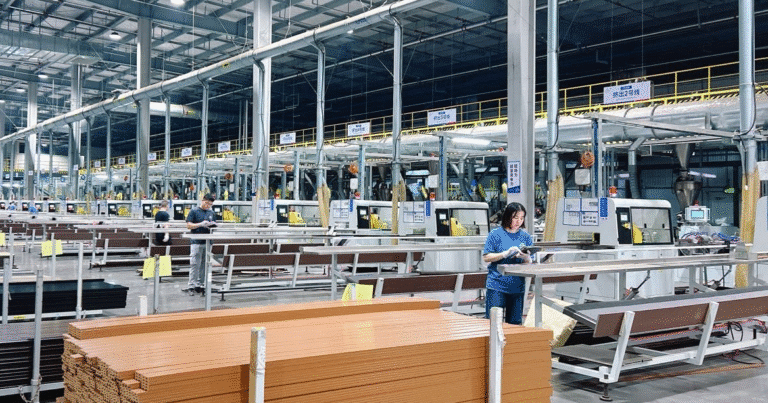
For large orders exceeding $50,000, factory site visits are strongly recommended. Factory visits not only give you direct insight into production capacity and quality control levels, but also build a foundation of trust for long-term cooperation. This helps avoid potential quality disputes and delivery delays later.
The value of factory site visits goes far beyond surface-level tours. By observing production processes on-site, checking equipment conditions, and communicating with technical staff, you can accurately assess suppliers’ real capabilities. Face-to-face communication also helps establish a solid foundation for future cooperation.
Key Factory Inspection Items
🏭 Production Equipment Assessment:
- Extruder models, quantities, and technical levels
- Mold inventory and manufacturing capabilities
- Advanced level of surface treatment equipment
- Production line automation level and capacity
🔍 Quality Control Inspection:
- Raw material storage and batching systems
- Production process quality monitoring point setup
- Finished product testing equipment and standards
- Non-conforming product handling procedures
What Are the MOQ Requirements for Composite Fence?
Chinese WPC fence manufacturers typically have a minimum order quantity of one 20ft container, approximately 25-30 tons, equivalent to 1000-2000 meters of fencing.
Standard specification composite fence panels have relatively low minimum order quantities because they can be mixed with other orders for production, starting from 200 square meters. Custom specifications or special color products require separate mold making or formula adjustments, so minimum order quantities are no less than 500 square meters.
MOQ standards in different situations
📦 Standard Specification Products:
- Regular color composite fence panels (wood grain, gray): 20-25 tons/batch
- Standard sizes (1.8m high, various widths): 25-30 tons/batch
- Stock products: 5-10 tons ready to ship
- Mixed orders: Total 20 tons (about one 20ft container)
🎨 Custom Products MOQ:
- Special color composite fencing: 50-100 tons (requires special formulation)
- Non-standard sizes: 30-50 tons (may require new molds)
- Surface texture customization: 100+ tons
- New product development: 200+ tons
How Long Does Composite Fence Shipping and Delivery Take?
WPC fence shipping time from China to major global markets typically takes 15-35 days.
MOQ standards in different situations
🏭 Production Stage:
- Standard specification stock: 3-7 days preparation
- Regular production orders: 15-25 days
- Custom specification composite fence panels: 25-35 days
- New product development: 45-60 days
🚢 Logistics and Shipping Stage:
- Factory to port: 2-5 days (domestic transport in China)
- Ocean freight time: 15-35 days (depends on destination)
- Port customs clearance: 3-7 days
- Last mile delivery: 1-3 days
What Payment Terms Do Chinese WPC fence Suppliers Typically Offer?
The standard payment terms for Chinese composite fence suppliers are 30% T/T advance payment, 70% payment before shipment.
For new customers, manufacturers typically require higher advance payment ratios to control risks. However, payment ratios can be negotiated for long-term cooperation.
Common payment methods
💳 Telegraphic Transfer (T/T):
- New customers: 30-50% advance + 70-50% balance
- Existing customers: 20-30% advance + 80-70% balance
- Handling fee: About 0.1-0.25%
- Processing time: 1-3 business days
🏦 Letter of Credit (L/C):
- Suitable for large orders: $50,000 and above
- Opening fee: About 0.15-0.5%
- Bank confirmation fee: About 0.1-0.3%
- Advantage: Risk protection for both parties
Payment terms for different stages of cooperation
| Cooperation Stage | Payment Ratio | Available Methods | Risk Level | Negotiation Space |
|---|---|---|---|---|
| First-time Cooperation | 50%+50% | T/T, L/C | High | Small |
| 2nd-5th Cooperation | 30%+70% | T/T, L/C | Medium | Medium |
| Long-term Cooperation (6+) | 20%+80% | T/T, L/C, OA | Low | Large |
| VIP Customers | 15%+85% or Monthly | Multiple Options | Very Low | Very Large |
For more information about composite fencing products or to request samples, please contact our professional team at Ecoxplank. We provide free sample services and technical consultation support.